
IMF chief Christine Lagarde has been put under formal investigation by French magistrates for alleged negligence in a political fraud affair dating from 2008 when she was finance minister.

Tibet is not this desolate, god-forsaken land that you have imagined it to be, discovers Saisuresh Sivaswamy.

'Is a rapidly growing working-age population a prerequisite for growth or a social tinderbox?'

A key UN climate change summit that will be attended by nearly 150 world leaders including Prime Minister Narendra Modi kicks off on Monday under the shadow of the deadly Paris terror attack to try to craft a long-term deal to limit carbon emissions.

Indian sports had a lot to celebrate despite a decrease in the medal count at the 2014 Asian Games in Incheon.

Make in India has few advantages and some disadvatnages too.

During a war, there are just four possibilities a soldier faces. One: Victorious and safe. Two: Wounded. Three: Killed in action. Four: Prisoner of War. It was my fate to face the fourth, says Colonel Anil A Athale (retd) on the year spent as a prisoner of war in Pakistan during the 1971 War.

Modi today needs BJP CMs and non-party regional leaders to win votes and build alliances, but he will over-rule them and treat them like dirt once they have served their electoral purpose. Make no mistake: Modi is incurably authoritarian and will brook no dissent -- so long as the RSS is on board, says Praful Bidwai.
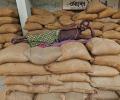
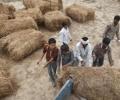
The agrarian crisis must be met with similarly speedy responses.
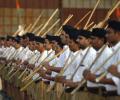
'We do not oppose any parent admitting his child to any English school.' 'We are opposed to the government grants that are to be given to such institutions.' 'If local languages are to be kept alive, at least they have to be taught at the primary level.'

Ignoring all previous protests and opposition to the deal, the saffron party has changed its stance, without providing any explanation. What has changed? Accountability and explanations on this U-turn will be welcomed.
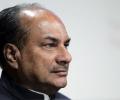
'The defence minister is stuck in the trivial and frivolous with a clerical mindset merely to prove his so-called 'honesty" overlooking the primary aim of adding sufficient military muscle and firepower to the defence services,' says Bharat Verma.

In a historic decision, President Barack Obama announced a series of steps aimed at normalising relations with communist-ruled Cuba, with which the US had severed diplomatic ties decades ago imposing a series of sanctions on its island neighbour.

'The first thing they ask me and people like me is, are you a Pakistani spy? They don't call you an American or a Chinese spy; they only call you a Pakistani spy.' 'At first, a few inmates tried to attack me saying they would make me sing the national anthem, but another group rescued me from the assault. When I got out of jail, so many of them cried and asked me, "When will we see you again?"'
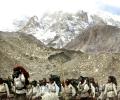
President Ram Nath Kovind presents the President's Colours to the Ladakh Scouts Regimental Centre today, August 21. These are normally presented to units that distinguish themselves consistently over decades. The Ladakh Scouts became a regular army regiment only in June 2001 after its stunning performance in the Kargil conflict, notes Ajai Shukla.

The 17th Asian Games came to a close on Saturday, bringing an end to two weeks of intense competition, drama and controversy that shone a light on the best and worst of a region that will host the world's biggest events for the next decade.

The US foreign and security policy establishment, says Ambassador M K Bhadrakumar, apprehends that Trump may compel them to exorcise the 'unipolar predicament', and bring foreign and security policies to reflect the desires and priorities of the American public.

'Through a translator, I was able to speak with several of the detainees from India who are seeking asylum.' 'I was saddened to hear the detainees tell us that they are being confined in their cells for up to 22 to 23 hours a day.' 52 Indian are among the 121 asylum-seekers held in an Oregon prison. Rediff.com Senior Contributor Pottayil Rajendran reports from New York on the case that is making headlines in America, India, indeed around the world.
